The Best Diabetes Devices Show Your Number Every 5 Minutes. None of Them Tell You Why It Keeps Rising

What are the best diabetes devices right now? For most adults with type 2, the newest diabetes technology is the wearable glucose sensor, a small patch that sends a reading to your phone as often as every few minutes, and some no longer need a prescription. It is a real step forward for seeing the number. But a diabetes monitoring device measures; it does not explain. If your line keeps drifting up on a careful day, the reason sits somewhere the sensor cannot reach.
"Best diabetes devices." That is what Pat's daughter typed into the search bar in August, then "diabetes monitoring device," then, late that night, "what is the newest treatment for type 2 diabetes." By Friday a small white sensor was on the back of Pat's left arm, and a graph that updated every five minutes was on her phone. Pat is 64, a retired dental receptionist from Chattanooga, Tennessee, with type 2 diabetes for eleven years. She thought the new diabetes technology would finally calm her down.
It did the opposite. "Before, I pricked my finger twice a day and got two numbers," she says. "Now I get two hundred and eighty-eight. And I watch every single one go up."
Does this sound like you?
- You bought a sensor, or someone bought one for you, and you check the app more than you check the weather
- Your line climbs after a meal you were proud of, and you have no idea why
- It rises in the morning before you have eaten a thing
- The phone buzzes with a high alert and your stomach drops before you even look
- Your A1c at the last visit was the same as before the sensor, or a little higher
If that is you, you are not doing it wrong. You are asking the device a question it was never built to answer.
What the newest diabetes technology does well
To be fair to the device: a continuous glucose sensor can help. It shows patterns a finger stick misses, like the slow climb after a "healthy" bowl of oatmeal or the overnight dip. At Europe's largest diabetes meeting in Milan at the end of September 2026, a sensor maker presented records from about 14,000 insulin users with type 2 who wore sensors, matched against 14,000 who didn't, and reported fewer deaths and heart complications in the sensor group. It was an observational analysis, not a trial, and the company paid for it, but doctors are paying attention.
Sensors can absolutely help you learn. But read what the same research world is saying about the people wearing them. A co-design study published in Frontiers in Health Services in August 2026 put it plainly: the sensors "provide valuable real-time data," but "they can also cause stress." Participants wrote about "data overload" and about it being "all too much to take in."
A thermometer tells you that you have a fever. It has never once told anyone where the infection is. A glucose sensor is a very good thermometer.
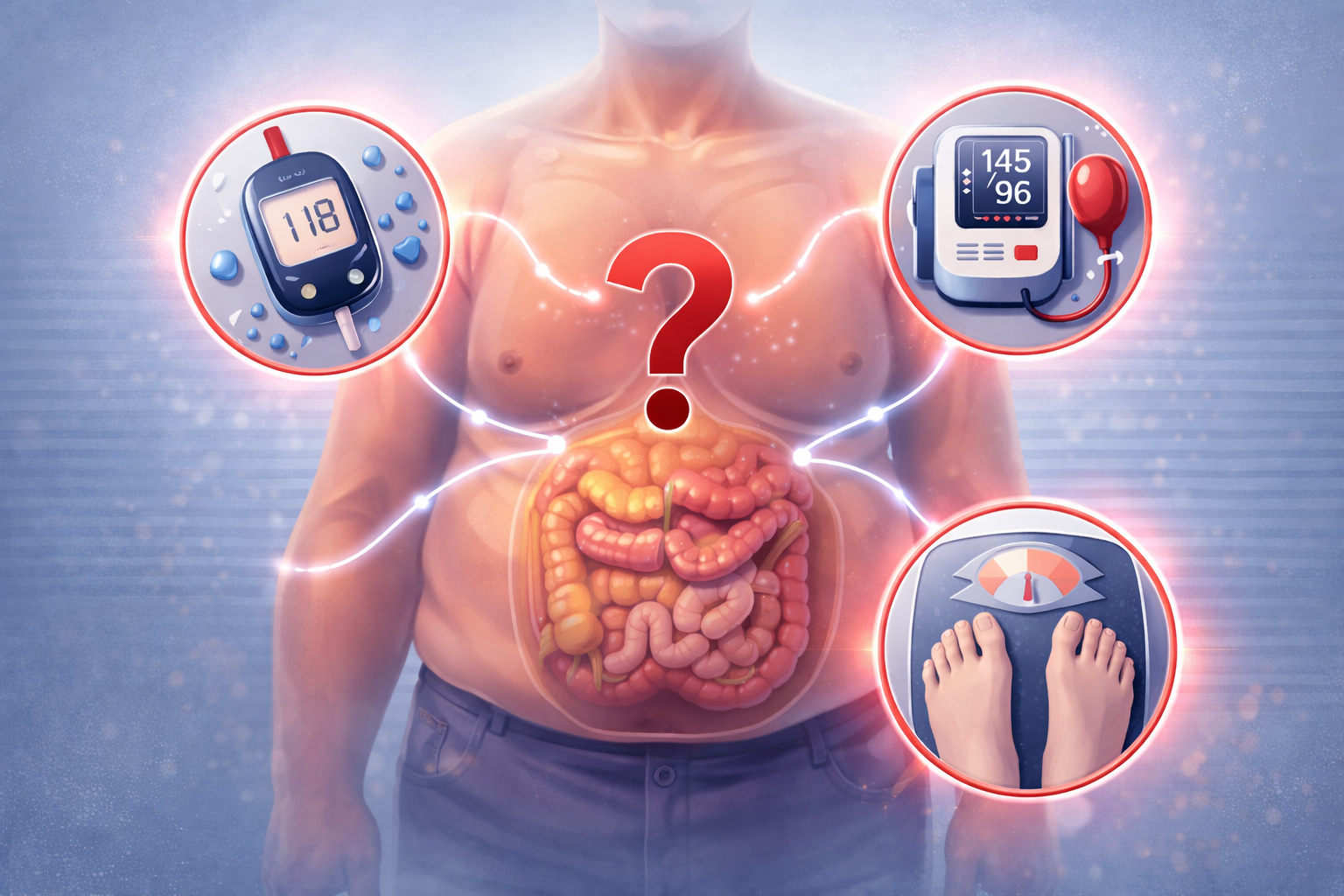
What Pat tried with the number in front of her
- Cutting the breakfast she loved. The line after her toast went down. The line at 10 a.m., with nothing in her stomach, kept climbing anyway.
- Walking after supper. It helped the hour after supper. It did nothing for the slow drift across the week.
- Turning off the alerts. Her daughter talked her into it. She still opened the app forty times a day "just to see."
Every one of those can help a little, and none of them is a mistake. But notice what they have in common: they all react to the number. Not one of them asks what is pushing it up in the first place, on a day when Pat did nothing wrong.
The question the graph keeps raising
Here is the part most of the "best device" lists skip. After you eat, your gut is supposed to send a signal, the body's own natural GLP-1, that does two jobs: it tells the pancreas to put out insulin in step with the meal, and it tells the brain "you already ate." In many people with type 2, that signal arrives weaker than it should, and the pancreas answering it has been working overtime for years.
A sensor shows you the result of that conversation every five minutes. It cannot show you the conversation. That is why a person can wear the newest device on the market, eat carefully, and still watch the line climb. The problem was never visibility.
The video a friend from choir sent
In September, Pat's friend Bev, who sings alto next to her on Sunday mornings and has worn a sensor herself since spring, sent her a long presentation with one line: "Watch this before you throw the phone across the room."
It follows a researcher, trained at a top university and for years on the inside of the drug industry, who watched someone she loved do everything right and still see the numbers climb. Her answer does not start with the plate or the device. She believes something settles in the gut and reaches the pancreas, wearing down the very cells that are supposed to respond when that natural GLP-1 signal shows up, and that this is why the line drifts up even on good days. She built a short morning habit around it.
That is her view, and MetabolicDaily has not verified it. What she believes is sitting there, what she uses against it, and why she says it belongs in the morning, before the first reading of the day, she explains in her own words. We are not going to give that away here.
You already know what the number is. This is the hour that asks why it keeps climbing.
Show me what the sensor can't seePat, after the video
Pat watched it on her iPad at the kitchen counter, the sensor app still open in the other window. "Somewhere in the first twenty minutes I stopped looking at the graph," she said. "That hasn't happened since August."
What got her was not a promise. It was the explanation. "For the first time, somebody was talking about why the line goes up, instead of telling me to look at it more."
She brought what she learned to her doctor before changing anything, which the presentation itself tells people to do, and she kept her metformin and her sensor.
What the graph showed, and how long it took
- Week 1. No change she could see. She started writing one number a day on the paper calendar, the 10 a.m. reading, instead of watching all of them.
- Weeks 2 and 3. A few mornings the 10 a.m. line stayed flatter than usual. Not every morning. She drew a small star on those.
- Month 1. More stars than blanks. The 3 p.m. pull toward the candy dish got quieter, and she noticed she was opening the app less.
- Months 2 and 3. The sensor's "time in range" crept up. Her A1c in December is the real test, and she says she will judge it by that, not by any single day.
Why so gradual? Because A1c reflects about three months of blood, and because eleven years of strain doesn't unwind in a weekend. Individual results vary, and nothing here replaces your medication or your doctor's advice.
"I stopped looking at the graph." If the app has become the first and last thing you check every day, start here.
Watch the video Bev sent Pat
Before you watch: who this is for
It may be for you if you wear a sensor or check often, your line keeps drifting up even on careful days, and you are tired of watching a problem you can't explain. It is also for the daughter or son who bought the device and now worries about the worry.
It is not a reason to stop your medication or your sensor. If you take insulin or anything that lowers blood sugar, talk to your doctor before adding anything new and keep checking, since your numbers can move. If you're pregnant or nursing, have kidney or liver problems, or your readings run very high with heavy thirst or blurry vision, call your doctor first.
Watch it all the way through. It is long because she shows her reasoning. Keep your phone face down for the hour.
The newest device shows you the problem 288 times a day. This may be the first time anyone explains it.
See why my line keeps climbingP.S. Pat's daughter still has that first search on her phone: best diabetes devices. She says the device was the right purchase, and the wrong place to stop. If you are standing at your own counter watching a line go up on a day you did everything right, watch the video Pat watched.
Further Reading
Why Is My Blood Sugar High in the Morning When I Didn't Eat?
The 3 a.m. answer behind the morning number
What Your 3 P.M. and 9 P.M. Sugar Cravings Are Trying to Tell You
The natural GLP-1 signal most A1c advice skips
Sources: Supporting continuous glucose monitoring for people with serious mental illness and type 2 diabetes: a co-design study for a structured intervention. Frontiers in Health Services, vol. 6, published August 20, 2026. Manufacturer-sponsored real-world analysis of CGM use in adults with type 2 diabetes on basal insulin, presented at the 62nd Annual Meeting of the European Association for the Study of Diabetes, Milan, September 2026 (observational; shows association, not cause). Reader accounts are shared with permission; names and some details have been changed. The views of the researcher featured in the presentation are her own and have not been independently verified by MetabolicDaily.
Medical Disclaimer: This article is for informational purposes only and does not constitute medical advice. Results vary. Statements about supplements have not been evaluated by the Food and Drug Administration, and supplements are not intended to diagnose, treat, cure or prevent any disease. Consult your healthcare provider before starting any supplement, especially if you take medication for blood sugar.